In This Article
Project team makes use of treasure trove of historic materials to ‘capture the genius’ of famed Seth Raynor layout

By Richard Humphreys |
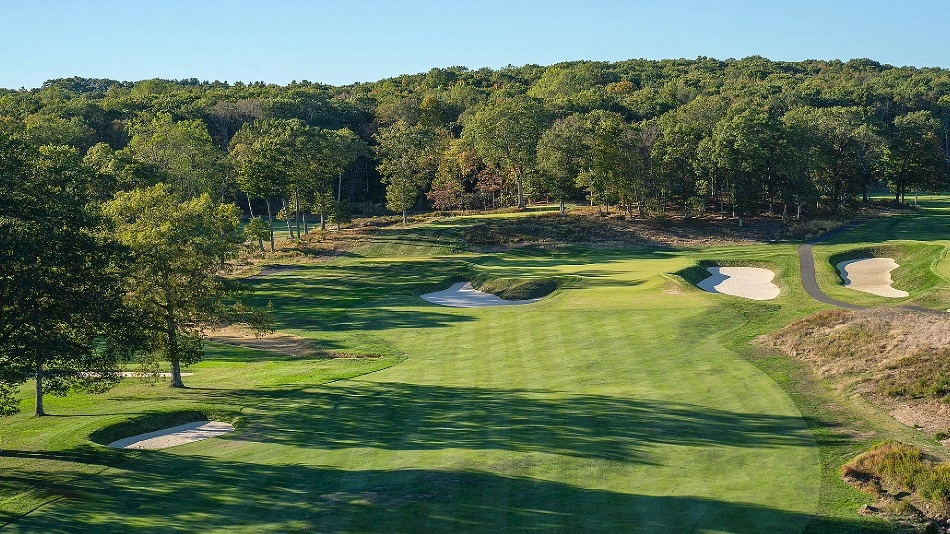
Yale Golf Course in New Haven, Connecticut, has reopened following a restoration by Hanse Golf Design.
The layout, which first opened in 1926, was designed by Seth Raynor – with Charles Blair Macdonald consulting – and it occupies a rocky, heavily wooded site four miles west of Yale University.
“Our primary goal throughout the restoration was to ensure an authentic and accurate revival of Raynor’s original vision,” said Ben Hillard, golf course architect at Hanse Golf Design. “This was a deliberate, research-driven process that guided every step of our work. From the outset, our team – Gil Hanse, Jim Wagner, Tanner Guyer, Brent Vest, Russ Myers and myself – approached Yale with a profound respect for Raynor’s architectural philosophy and his work. Our objective for this project was to identify what exactly Raynor built at Yale and to restore it faithfully.
“To achieve this, we invested significant time and energy in research and hands-on exploration during the construction phase. The restoration began with a holistic assessment of the entire site, considering its historical evolution, current functionality and day-to-day use. Gradually, our focus narrowed to an evaluation of individual holes and every aspect of their design: tees, bunkers, greens, playing surfaces, natural textures and the mowing lines.”
The project team made use of an array of historic materials to inform their design decisions, including 1930s aerial photographs, original hole descriptions by Charles Banks (an associate of Raynor on the project), original construction progress reports, plus articles and reviews from the course’s opening.
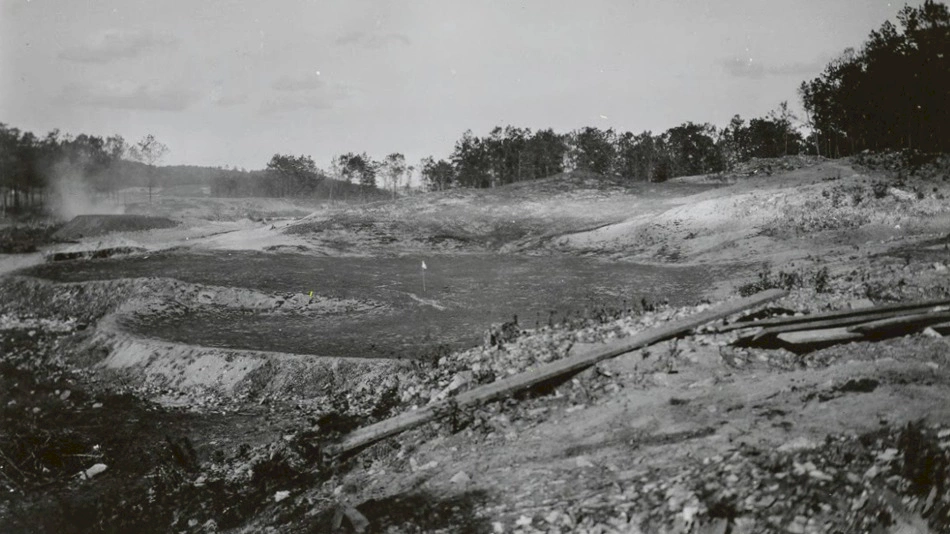
An archive photo that shows the original Double Punchbowl third green... (Photo: Yale Golf Course)
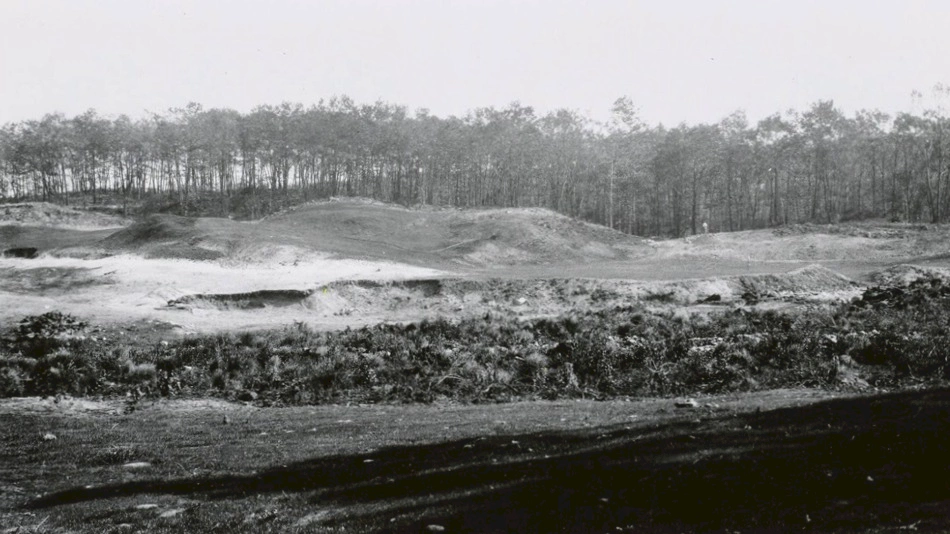
… and a photo of the same green, taken from the fourth fairway. “This photo was a great resource as it shows how the two Punchbowls were created," says Ben Hillard (Photo: Yale Golf Course)
“Insights from former Yale Men’s Golf Team coach Colin Sheehan have been invaluable,” said Hillard. “Colin’s extensive knowledge of the course’s evolution, including personal anecdotes from long-time players, provided context that helped us interpret subtle design features, such as the nuanced contours of the tenth green, which once funnelled well-played putts to specific pin locations.”
Two resources were especially instrumental in Hanse Golf Design’s efforts: the Yale archives and the course itself. “The archives offered a rich photographic chronicle of the course’s original construction, featuring multiple perspectives of each hole throughout various stages,” said Hillard. “While the course, remarkably preserved beneath decades of superficial alterations, served as an archaeological site. With careful investigation, we uncovered many original features.
“Throughout nearly a century of evolution, the course had experienced inevitable changes: overgrown vegetation, reduced fairways and greens, modified or abandoned bunkers, and new or altered tees.”
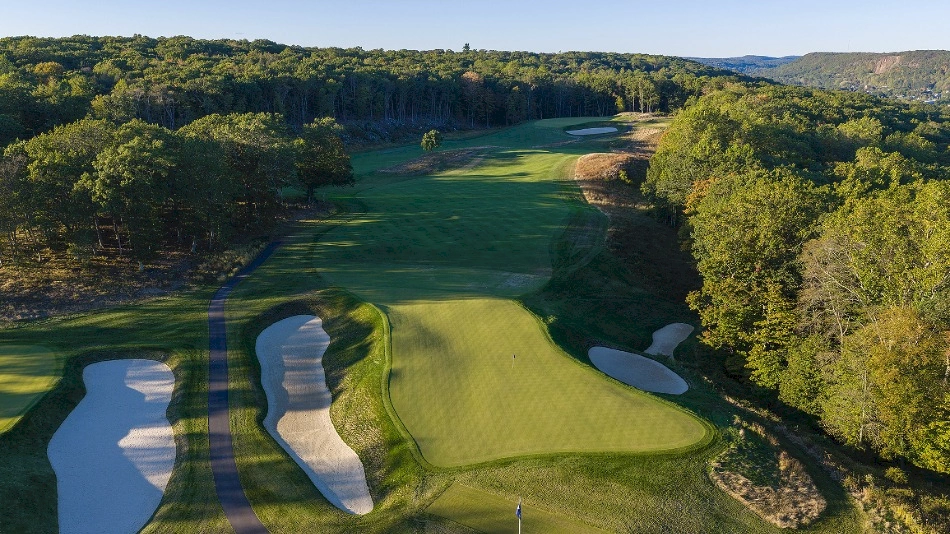
The restoration has covered greens, fairways, bunkers, vegetation, trees and more (Photo: Evan Schiller)
The restoration began with an extensive vegetation management plan, which reopened playing corridors and allowed for the original scale of fairways and greens to be restored, reintroducing lost angles of play. Every green was also expanded, back to its intended dimensions.
“Our research revealed that greens on one, five, six, nine, ten, thirteen, seventeen and eighteen had undergone changes over the years,” said Hillard. “Fortunately, since none of the putting surfaces had ever been completely rebuilt, we could look at the distinct soil layers within each green’s profile and identify the original material Raynor used to finish the surfaces in 1925. By carefully excavating the various layers, we traced this foundational layer across the entire green, enabling us to accurately restore the original contours.
“Once we confirmed that the restored slopes and potential pin placements would accommodate modern green speeds, we employed 3D mapping technology to scan the greens. This allowed us to reconstruct each green profile and recreate Raynor’s original contours.”
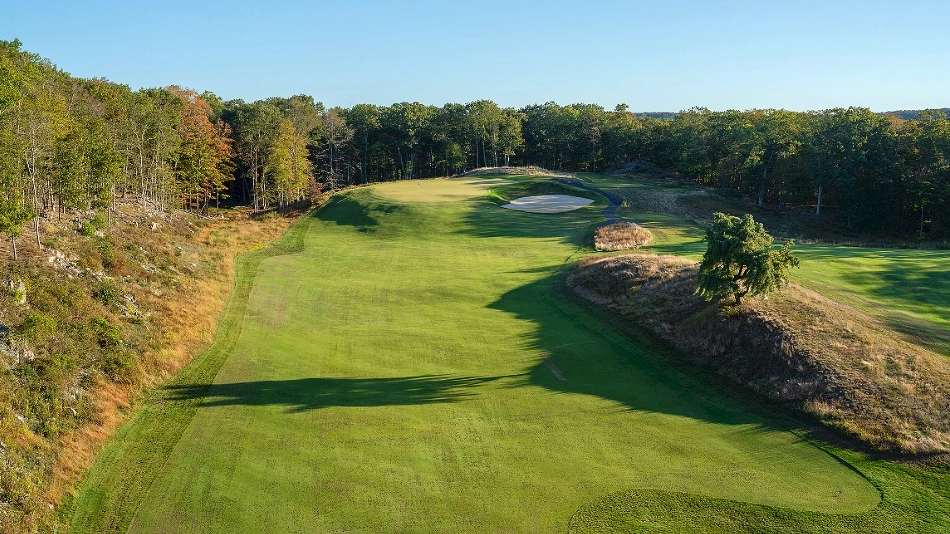
Hanse’s team have restored slopes and ensured that pin positions would work at modern green speeds (Photo: Evan Schiller)
One of the biggest changes was on the third, an Alps hole with a Double Punchbowl green. “Several key features of this hole had been changed over time,” said Hillard. “The original green was no longer there. The precise timing and rationale behind the modifications to the third green remain a mystery, likely occurring between the 1940s and 1960s. Restoring the Double Punchbowl became a pivotal and exhilarating aspect of our project. We discovered that the newer green had been built three to four feet above the original surface using imported material. Through careful excavation, we uncovered substantial remnants of the original green, along with the bunker situated on the right side. Supplementing these findings, archival photographs taken from multiple angles provided essential details and helped us piece together the original contours and green surrounds.
“Raynor had incorporated a section of fairway feeding into the green from over the Alps mound. This fairway, functioning almost like a catcher’s mitt, offered golfers a creative avenue for approach shots and recovery. Over time, however, this fairway was abandoned and became engulfed by tall grasses and dense shrubs. With the fairway now restored the original strategy and design intent of the hole can be seen and the third is a fine example of the Alps-Punchbowl templates Raynor designed elsewhere, notably the fourth at Fishers Island.”
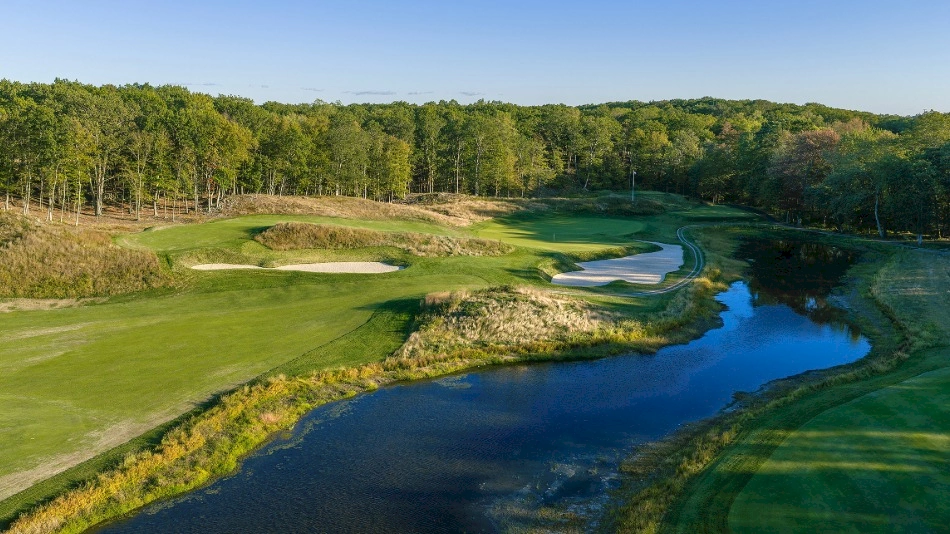
Hanse’s work on the third included reinstating the second fairway area that funnels balls towards the putting surface, and recreating the Double Punchbowl green (Photo: Evan Schiller)
On the sixth hole, two ‘inverted’ bunkers – where the sand lies on a mound, rather than in a depression – have been restored, and all the course’s bunkers have been renovated, using liner from Better Billy Bunker. The course’s irrigation system is from Rain Bird.
“Yale Golf Course stands as perhaps the boldest example of golf course architecture in the United States, a synergy of Raynor’s daring design and a remarkable landscape,” said Hillard. “Our team’s intent was not simply to renovate, but to inform and illuminate the restoration process, ensuring that every decision was rooted in historical accuracy and respect for Raynor’s legacy. The result is a course that once again captures the essence of its original genius, offering players the unique experience Raynor envisioned nearly a century ago.”